

What Is Deep Learning?
When a doctor uploads an MRI scan and an AI flags a tumour in seconds, that is deep learning. When your learning app adjusts the next lesson based on how you just performed, that is deep learning. When a farmer gets a crop yield prediction based on last week's rainfall, soil pH, and satellite imagery, that is deep learning too.
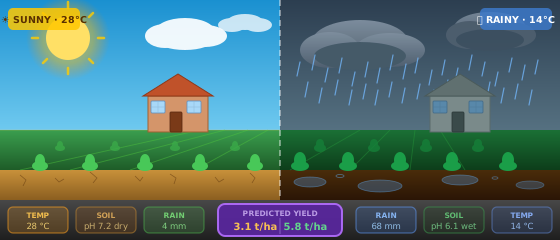
Training a neural network, whether it has three layers or three hundred, is what we call deep learning.
The "deep" simply refers to the number of layers in the network. More layers let the model build richer, more abstract representations, moving from raw sensor readings all the way to real-world predictions.
Deep learning = training neural networks on data so they learn patterns automatically, without you writing the rules.
A company wants to detect defects in factory products from photos. Which approach makes more sense?
What Deep Learning Is Good At
Deep learning does not replace every approach. You get the best results when three conditions hold.
- Your input is high-dimensional raw data. Images, audio, text, and sensor streams have far too many raw features for a human to design manually. For e.g., deciding which combinations of soil readings, rainfall patterns, and temperature signals predict crop yield by hand is not feasible. A network learns that directly from data.
- You have a large number of examples. Deep networks have millions of parameters and need large datasets to learn well and not overfit. For e.g., in a crop yield predictor, hundreds of thousands of historical farm records (rainfall, soil type, fertiliser used, final yield) give the model enough signal to generalise to fields it has never seen.
- Compute is available. Training on millions of examples requires heavy matrix arithmetic. Modern GPUs and cloud infrastructure make this accessible even to small teams.
| Condition | Classical ML | Deep Learning |
|---|---|---|
| Small, structured dataset | ✓ Strong | ✗ Often overfits |
| Raw images / audio / text | ✗ Needs manual features | ✓ Learns features automatically |
| Interpretability required | ✓ Easier to inspect | ✗ Harder to explain |
| Large dataset + raw inputs | ✓ Decent | ✓ State of the art |
Strong current applications:
- Healthcare: tumour detection in scans, drug interaction prediction, early disease screening
- Personalised education: adapting lesson difficulty, identifying knowledge gaps, generating practice problems
- Precision agriculture: crop yield prediction, pest detection from drone imagery, irrigation optimisation
- Natural language: translation, summarisation, code generation
- Generative AI: image synthesis, video generation, protein structure prediction
Why Has Deep Learning Taken Off Now?
The mathematics behind neural networks is decades old. What changed is the convergence of three forces, all at the same time.
- Data. Digitisation of everyday life created datasets at a scale that simply did not exist before. Health records, satellite feeds, e-commerce logs, and mobile sensors all contribute. For e.g., the ImageNet dataset with 1.2 million labelled images was a turning point for computer vision in 2012. Your crop yield predictor benefits from the same shift: government agriculture databases and IoT soil sensors now produce exactly the kind of data that makes training possible.
- Compute. GPUs were built to render graphics by running thousands of parallel matrix operations, which happens to be exactly what training a neural network requires. Cloud access to GPU clusters means you can now train a model in hours that would have taken months on CPU hardware a decade ago.
- Better algorithms. Early networks struggled to train reliably at depth. Key improvements made deep networks stable and practical: better activation functions, smarter weight initialisation, batch normalisation, and optimisers like Adam. These are not minor tweaks; they are the difference between a network that learns and one that does not.
Data, compute, and algorithms all had to improve together. Any one of them alone was not enough. The explosion happened when all three crossed a threshold at the same time.
A research team in 1995 had the right neural network architecture but couldn't get strong results. What was most likely the bottleneck?