
Neural Networks and Supervised Learning
Neural networks are at their most powerful when applied to supervised learning. You give the network labelled training examples — inputs paired with known correct outputs — and it adjusts millions of internal weights until its predictions match those labels. Once trained, the network can predict outputs for inputs it has never seen.
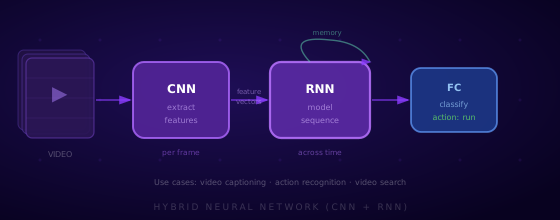
Our crop yield predictor from earlier is a clean example of this. You have soil quality, rainfall, temperature, and fertiliser amount as inputs. The label is the actual yield measured at harvest. The network sees thousands of these input-label pairs, adjusts its weights through backpropagation, and learns a complex function that maps those four inputs to an accurate yield prediction. It does not matter that the relationship is nonlinear or that the inputs interact in subtle ways — the network learns all of that from the data, without you writing a single rule.
Every major AI application below follows the same pattern as the crop yield predictor: inputs, labels, a neural network that learns the mapping, and a trained model that generalises to new data.
Real-World Applications
Neural networks are not a research curiosity. They are the engine behind products used by billions of people every day. Here are five of the most impactful applications in use right now.
1. Targeted Advertising
Every time an ad appears on your screen, a neural network decided it was the right one to show you. Companies like Google, Meta, and TikTok feed each user's behaviour — browsing history, location, purchase signals, time of day — into a neural network trained to predict the probability you will click or convert. The label during training was simple: did this user click this ad or not? Trained on hundreds of billions of such examples, the model learns which combinations of user signals predict engagement for which categories of ads, and serves personalised content in under a millisecond.

2. Computer Vision
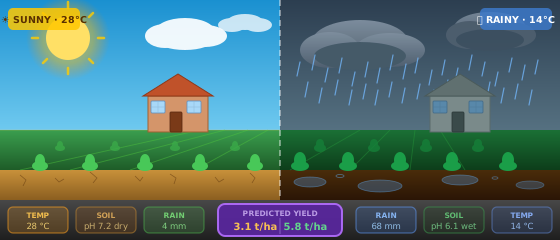
Self-driving cars, medical imaging tools, and quality control systems on factory floors all rely on convolutional neural networks trained on labelled images. Tesla's Autopilot processes camera frames and identifies cars, pedestrians, road signs, and lane markings in real time. During training, engineers labelled millions of image frames with bounding boxes and category names. The network learned to detect those objects in new frames it had never seen. For e.g., a model trained to flag lung nodules in chest CT scans learned that pattern from thousands of scans annotated by radiologists — it now matches specialist-level accuracy on early detection.
3. Speech Recognition
When you say "Hey Siri" or ask Alexa a question, an RNN (or Transformer) converts the raw audio waveform into text. The training data consisted of millions of hours of audio paired with human-written transcripts — those transcripts were the labels. The model learned which acoustic patterns correspond to which words, across accents, noise levels, and speaking speeds. Apple, Amazon, and Google have each trained on datasets large enough that their models now achieve word error rates below five percent in normal conditions — better than many human transcriptionists.

4. Recommendation Systems
Netflix, Spotify, and Amazon all use neural networks to decide what to show you next. The training data is your watch history, ratings, skips, and pauses — all paired with labels indicating whether you completed something or rated it highly. Collaborative filtering models extend this further, learning that users who liked what you liked also tended to like a set of things you have not seen yet. Netflix estimates that over 80% of what people watch is discovered through recommendations rather than direct search, making the recommendation model one of the most commercially important neural networks ever deployed.

5. Fraud Detection
Visa, PayPal, and Stripe each process millions of transactions per second and flag suspicious ones in real time using neural networks. Every transaction is a feature vector: amount, merchant category, location, time since last transaction, device fingerprint. During training, past transactions were labelled as fraudulent or legitimate by analysts. The network learned what combinations of features signal fraud — an unusually large foreign ATM withdrawal two minutes after a domestic coffee purchase, for example. Modern fraud models operate with false positive rates below 0.1%, meaning genuine transactions are almost never blocked.

Types of Neural Networks
The five applications above all use neural networks, but not the same kind. Different architectures are designed for different types of data and problems. We will cover all of these in depth in the modules ahead — for now, here is the landscape.
Every architecture below is a neural network at its core. What differs is how the layers are connected and what kind of data each connection pattern is designed to process.
1. Standard Neural Network (MLP)
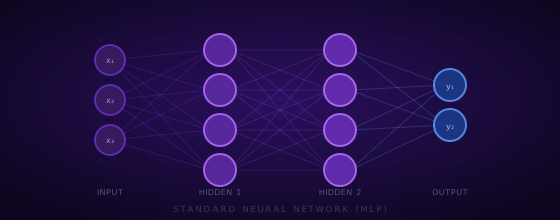
A standard feedforward network, also called a Multi-Layer Perceptron, passes data in one direction — from input layer through hidden layers to output. Every neuron in one layer connects to every neuron in the next. This is the architecture behind our crop yield predictor. It works well for structured, tabular data where the order of inputs does not matter and spatial relationships are not important.
2. Convolutional Neural Network (CNN)
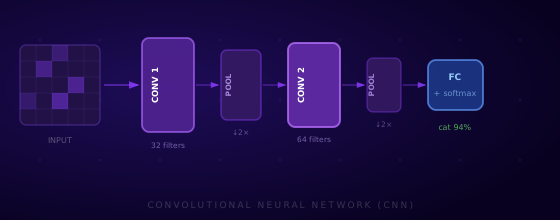
CNNs are designed for grid-structured data — primarily images. Instead of connecting every neuron to every other, a CNN slides small filters (kernels) across the input to detect local patterns like edges, textures, and shapes. Deeper layers combine these local patterns into higher-level features. CNNs power computer vision: autonomous vehicles, medical image analysis, facial recognition, and product defect detection all use them.
3. Recurrent Neural Network (RNN)
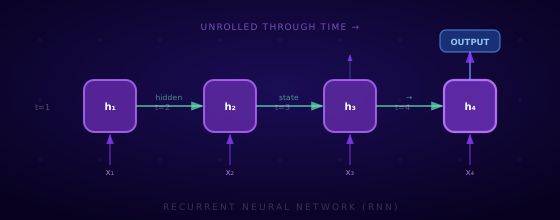
RNNs are designed for sequences — data where order matters. Each step in the sequence passes information to the next through a hidden state, giving the network a form of memory. This makes RNNs natural fits for speech recognition, text generation, time-series forecasting, and translation. Modern variants like LSTMs and GRUs solve the problem of RNNs forgetting information from early in a long sequence.
4. Hybrid Neural Network
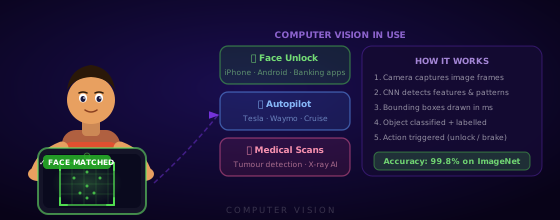
Hybrid architectures combine layers from different network types to handle problems that involve more than one kind of structure in the data. For e.g., a video classification model might use a CNN to extract visual features from each frame and then feed those feature vectors into an RNN to capture how the scene changes over time. Caption generation models do the same: a CNN reads the image, an RNN generates the descriptive sentence. Hybrids let you match the architecture to the problem rather than forcing all problems into one shape.